OpenForum Europe and the UN Open Source Week 2025

UN launched the UN Open Source Week 2025 Conference Report at OpenForum Europe’s EU Open Source Policy Summit 2026. This marks the fourth collaboration between the UN and OFE. With the 2026 edition approaching on 22–26 June 2026, revisiting the 2025 conference report provides valuable insights, inspiration, and a clear sense of what to expect.
Omar Mohsine (Open Source Coordinator, UN-ODET) and Arnau Monterde (Director of Participation and Innovation for Democracy, Barcelona City Council) joined Sachiko Muto (Chair, OpenForum Europe) to launch the report, authored by Muto.
The report highlights the key themes and outcomes of UN Open Source Week 2025, showcasing how open source has become a cornerstone of multilateral digital cooperation. With the 2026 edition approaching on 22–26 June 2026, revisiting the 2025 conference report provides valuable insights, inspiration, and a clear sense of what to expect.
UN Open Source Week 2025: A Global Collaboration
How can open source shape a more inclusive and sovereign digital future? At the UN Open Source Week 2025, policymakers, technologists, and community leaders came together to answer exactly that, moving beyond theory into hands-on collaboration from the start.
Over five days, participants combined high-level discussions with practical teamwork, co-creating solutions for UNICEF platforms, expanding Wikipedia’s coverage of digital policy, and sharing lessons from government OSPOs. The message was clear: open source is now a foundation for transparent governance, trusted AI, and cross-border cooperation.
On the second day, as part of the LinkedIn side event, a breakout session titled “Open Source Skills in the AI Era: Perspectives from the European Open Source Academy” was moderated by Nicholas Gates, Senior Policy Advisor at OpenForum Europe. The panel featured Sachiko Muto and Walid Mathlouthi (ITU) alongside members of the European Open Source Academy, including Amandine Le Pape (COO and Co-Founder of Element and Co-founder of the Matrix.org Foundation) and David Cuartielles (Co-founder of Arduino and Senior Lecturer at Malmö University).
The discussion focused on what skills are needed in an AI centric economy to maintain open source innovation. Speakers empathised that cross-sector collaboration to upskill the labour force is essential. They also underscored that open source can act as a democratic tool, ensuring AI benefits are accessible to all.
“AI is reshaping how open source is built and sustained. It’s not just changing tools, but the skills and collaboration models we rely on across communities. Our challenge is to adapt quickly while preserving the openness and shared foundations that make this ecosystem work.” – Nicholas Gates
Beyond the activities, panels and discussions delved into overarching themes: the power of the digital commons, building trustworthy AI, bridging the digital divide, and leveraging open source for inclusive innovation.
Day three highlighted Open Source Program Offices (OSPOs). From governments to universities and private companies, OSPOs are planting seeds of collaboration, embedding openness in policy, and supporting sustainable systems. Panels and breakout sessions explored topics ranging from ethical AI to InnerSource practices.
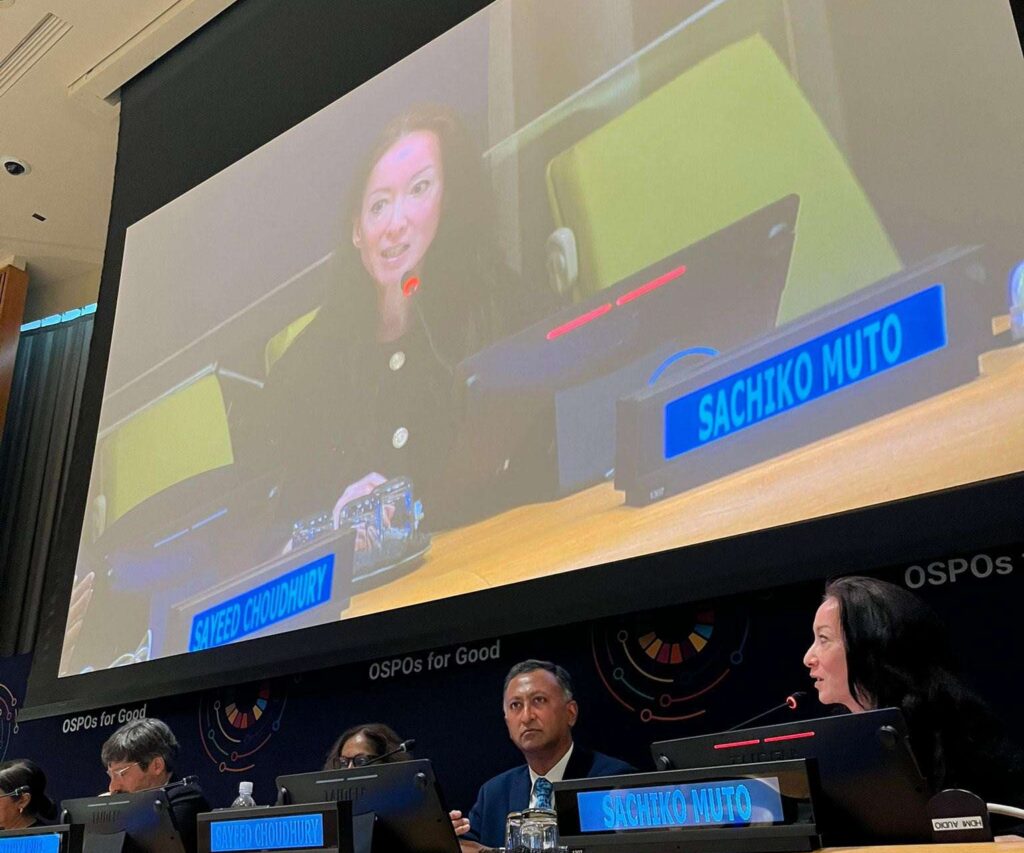
Sachiko led one of these sessions as moderator for a panel on newly launched OSPOs. The panel explored what it takes to move from high-level endorsement to unlocking the potential of open source. OSPOs serve as an anchor for openness, a place where code, compliance, and community can coexist.
Participants noted that structure is not enough: trust, sovereignty, and inclusion are critical to OSPO design. In addition, they emphasised the importance of reconciling internal organisational priorities with open source practices. The consensus was clear: an OSPO’s role is to bridge the gap between resistant systems and the open practices that challenge and reshape them.
Speakers at the Summit 2026 “OSPOs as Sovereignty Engines” panel, reached a similar conclusion, underscoring the importance of OSPO’s and the need to strengthen institutional capacity, governance, and strategic collaboration through them, stressing that their expansion across Europe will be essential to support digital sovereignty and long-term technological resilience.
Astor Nummelin Carlberg, former Executive Director of OFE, led an interactive breakout session on Open source and Public Interest. The discussion explored how open source supports the public interest by strengthening digital sovereignty, transparency, and trust in public institutions, while also fostering collaboration across governments, civil society, and the private sector.
The session emphasised that more policy frameworks must recognise open source as a strategic public good and empower communities to take an active role in the direction of digital transformation. After the discussion, participants agreed that aligning open source adoption with public interest values is essential to creating an inclusive, secure, and sustainable digital ecosystem.
Day four focused on Digital Public Infrastructure (DPI) and how open, interoperable systems can support societal development. Examples from India, Brazil, Estonia, and Kazakhstan showed how DPI can expand financial inclusion, improve public services, and support economic growth. Discussions also highlighted the importance of cross-border cooperation, AI integration, and safeguards. Speakers pointed out Africa’s growing momentum in deploying scalable DPI and remarked that improving interoperability could help increase regional trade, which currently remains lower than trade with the European Union.
The final day celebrated the power of the open source community. The day was packed with a full slate of 20 community-organised side-events across five tracks: Digital Public Infrastructure (DPI), Digital Sovereignty and Resiliency, AI, Capacity Building, and Global Priorities and SDGs. The UN highlighted initiatives like the Open Source Policy Framework, UN Open Source Principles, and the UN Open Source Catalogue. The Community events focused on creating a collaborative space where practitioners, maintainers, civic technologists, policymakers, and funders could engage directly. The program featured interactive short talks and workshops, empathising on connecting people from across sectors and regions.
UN Open Source Week 2025 highlighted how collaboration, open source, and digital public infrastructure are the engines driving meaningful global change. With the 2026 edition on the horizon, we look forward to continuing our engagement by participating in the Community Day of the 2026 edition.

Read the full report for a comprehensive overview of the activities and insights of the conference.